CLIENT BRIEFING REPORT
Musqueam Indian Band Rights Recognition Agreement
Signed February 20, 2026 | Prepared for Client Distribution Key Facts at a Glance Agreement Name
šxʷq̓ʷal̕təl̕tən Rights Recognition AgreementParties
Musqueam Indian Band and His Majesty the King in Right of Canada Date Signed
February 20, 2026 Signed By
Chief Wayne Sparrow (Musqueam) and the Honourable Rebecca Alty, P.C., M.P. (Canada)Source
Crown Indigenous Relations and Northern Affairs Canada (CIRNAC)Nature of Agreement
Rights recognition and reconciliation framework — NOT a land cession or treaty
Legal Status Does NOT constitute a treaty under sections 25 or 35 of the Constitution Act, 1982
Who Are the Musqueam? The Musqueam Indian Band (xʷməθkʷəy̓əm) are the original hən̓q̓əmin̓əm̓ speaking peoples whose territory has been continuously occupied for well over 8,000 years. Their traditional lands encompass a significant portion of what is now Metro Vancouver, including key areas relevant to real estate in the region.
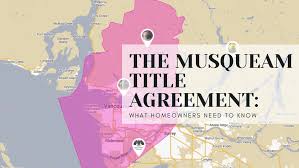
Musqueam Territory Defined Boundaries. The Musqueam Territory is formally defined in the agreement as the lands, lakes and streams bounded by:
Secondary Use Area Beyond the core territory, Musqueam also asserts a “Secondary Use Area” through historic kinship ties, covering portions of the broader Salish Sea and adjacent lands, extending up the Fraser River to the Fraser Canyon.
What Is This Agreement? This is a Rights Recognition Agreement, a formal, bilateral arrangement between the Musqueam Indian Band and the Government of Canada. Its primary purpose is to recognize Musqueam's existing Aboriginal Rights and Title formally and to establish a structured framework for progressively implementing those rights.
What the Agreement Does
Incremental Implementation Agreements (Annex A): Three specific implementation agreements are attached to or enacted concurrently with this Rights Recognition Agreement. These are separate, binding arrangements dealing with specific subject matters.
Agreement Details Revenue Sharing Agreement (YVR Airport)Effective February 24, 2025. Governs the sharing of federal lease revenues from Vancouver International Airport (YVR) between Musqueam and Canada (Transport Canada and CIRNAC).Stewardship and Marine Management Agreement
Effective concurrently with this Agreement (February 20, 2026). Involves Ministers of Fisheries, Transport Canada, Environment and Climate Change, Defence, and Crown-Indigenous Relations.Fisheries Agreement
Effective concurrently with this Agreement (February 20, 2026). Involves the Minister of Fisheries and Oceans Canada.
Legal and Constitutional Framework: This agreement operates within, and is shaped by, a specific legal and constitutional context that clients should be aware of. Section 35, Constitution Act, 1982
Recognizes and affirms the existing Aboriginal and treaty rights of Aboriginal peoples of Canada. Musqueam's Rights and Title are grounded in this constitutional protection. Musqueam's Aboriginal Title
The Supreme Court of Canada has confirmed that Aboriginal title is an inherent right constituting a legal interest in land, with both jurisdictional and economic components. Musqueam's title has NOT been extinguished.
Key Case Law Referenced
Sparrow, Guerin, and Delgamuukw foundational Supreme Court of Canada decisions confirming Aboriginal rights, the honour of the Crown, and the economic attributes of Aboriginal title.UN Declaration on the Rights of Indigenous Peoples (UNDRIP)
Canada has fully endorsed and enacted UNDRIP. This agreement explicitly commits to its implementation. Truth and Reconciliation Commission
Canada has committed to implementing the TRC's 94 Calls to Action. The TRC recommended UNDRIP as the framework for reconciliation.
What This Means for Real Estate Clients.
Duty to Consult Considerations: The agreement strengthens the formal relationship between Musqueam and Canada on federal matters. For projects or decisions involving federal jurisdiction (for example, federal Crown land, ports, airports, navigable waters), the duty to consult Musqueam is reinforced. For most private residential and commercial real estate transactions, this agreement does not impose new obligations on buyers or sellers directly.
Lease Revenues from Federal Land. One concrete financial outcome of the agreements is the sharing of YVR airport lease revenues between Canada and Musqueam — a precedent-setting economic reconciliation measure. This demonstrates the economic dimension of Musqueam's rights as recognized in Canadian law.
Ongoing Negotiations: This agreement explicitly contemplates future negotiations (Part 7). Additional Incremental Implementation Agreements will be negotiated over time, which may expand the scope of Musqueam's formally recognized authority in areas such as stewardship, fisheries management, and potentially others. Clients should monitor developments in this area over the coming years.
Musqueam's Existing Land Holdings. Musqueam already owns and manages significant real estate interests in Vancouver, including Musqueam Indian Reserve No. 2 near Sea Island, and long-standing lease arrangements with residential neighbourhoods in the Dunbar and University area. This agreement is separate from those existing arrangements.
Dispute Resolution Process. The agreement establishes a structured, multi-stage dispute resolution process for disagreements between Musqueam and Canada.
Note This dispute resolution process applies to disagreements between Musqueam and Canada only it does not directly apply to private real estate disputes. Key Principles of the Agreement: The agreement is underpinned by the following Fundamental Principles (Part 3):
Key Dates and Timeline 1976
Musqueam Declaration formal description of Musqueam Territory first published.2017
Musqueam and Canada sign Framework for the Recognition and Implementation of Musqueam Rights and Title.November 2018
Term sheets set out Musqueam's initial vision for incremental rights implementation.2019
Parties begin negotiating Incremental Implementation Measures on priority topics. February 24, 2025
YVR Revenue Sharing Agreement comes into effect (Annex A, Item 1).February 20, 2026
Rights Recognition Agreement (šxʷq̓ʷal̕təl̕tən) signed by Chief Wayne Sparrow and Minister Rebecca Alty.February 20, 2026
Stewardship and Marine Management Agreement and Fisheries Agreement also come into effect.
Who Are the Musqueam? The Musqueam Indian Band (xʷməθkʷəy̓əm) are the original hən̓q̓əmin̓əm̓ speaking peoples whose territory has been continuously occupied for well over 8,000 years. Their traditional lands encompass a significant portion of what is now Metro Vancouver, including key areas relevant to real estate in the region.
Musqueam Territory Defined Boundaries. The Musqueam Territory is formally defined in the agreement as the lands, lakes and streams bounded by:
- Starting at Harvey Creek in Howe Sound, proceeding eastward to the height of land
- Continuing around the entire watershed draining into English Bay, Burrard Inlet, and Indian Arm
- South along the divide between the Coquitlam and Brunette Rivers to the Fraser River
- Across to the south bank of the Fraser River's main stream and South Arm to the sea
- Including all intervening lands, islands, and waters back along the shoreline to Harvey Creek
- Including the sea, reefs, tidal flats, and islands adjacent to the above lands, out to the centre of the Strait of Georgia
Secondary Use Area Beyond the core territory, Musqueam also asserts a “Secondary Use Area” through historic kinship ties, covering portions of the broader Salish Sea and adjacent lands, extending up the Fraser River to the Fraser Canyon.
What Is This Agreement? This is a Rights Recognition Agreement, a formal, bilateral arrangement between the Musqueam Indian Band and the Government of Canada. Its primary purpose is to recognize Musqueam's existing Aboriginal Rights and Title formally and to establish a structured framework for progressively implementing those rights.
What the Agreement Does
- Formally recognizes Musqueam's unextinguished Aboriginal Rights and Title within Musqueam Territory
- Establishes Fundamental Principles to guide the ongoing nation-to-nation relationship
- Creates a framework of Incremental Implementation Agreements (IIAs) separate, specific agreements on individual topics
- Sets out a formal dispute resolution process (negotiation → mediation → arbitration or litigation)
- Commits both parties to future discussions and negotiations on additional topics
- Does NOT constitute a treaty or land claims agreement under the Constitution Act, 1982
- Does NOT create, amend, define, establish, extinguish, or abrogate Musqueam's Rights and Title
- Does NOT transfer land ownership or affect the title registered in the Land Title Office
- Does NOT restrict Musqueam Members from continuing to access federal programs and services
- Does NOT affect the rights of any other Aboriginal peoples
Incremental Implementation Agreements (Annex A): Three specific implementation agreements are attached to or enacted concurrently with this Rights Recognition Agreement. These are separate, binding arrangements dealing with specific subject matters.
Agreement Details Revenue Sharing Agreement (YVR Airport)Effective February 24, 2025. Governs the sharing of federal lease revenues from Vancouver International Airport (YVR) between Musqueam and Canada (Transport Canada and CIRNAC).Stewardship and Marine Management Agreement
Effective concurrently with this Agreement (February 20, 2026). Involves Ministers of Fisheries, Transport Canada, Environment and Climate Change, Defence, and Crown-Indigenous Relations.Fisheries Agreement
Effective concurrently with this Agreement (February 20, 2026). Involves the Minister of Fisheries and Oceans Canada.
Legal and Constitutional Framework: This agreement operates within, and is shaped by, a specific legal and constitutional context that clients should be aware of. Section 35, Constitution Act, 1982
Recognizes and affirms the existing Aboriginal and treaty rights of Aboriginal peoples of Canada. Musqueam's Rights and Title are grounded in this constitutional protection. Musqueam's Aboriginal Title
The Supreme Court of Canada has confirmed that Aboriginal title is an inherent right constituting a legal interest in land, with both jurisdictional and economic components. Musqueam's title has NOT been extinguished.
Key Case Law Referenced
Sparrow, Guerin, and Delgamuukw foundational Supreme Court of Canada decisions confirming Aboriginal rights, the honour of the Crown, and the economic attributes of Aboriginal title.UN Declaration on the Rights of Indigenous Peoples (UNDRIP)
Canada has fully endorsed and enacted UNDRIP. This agreement explicitly commits to its implementation. Truth and Reconciliation Commission
Canada has committed to implementing the TRC's 94 Calls to Action. The TRC recommended UNDRIP as the framework for reconciliation.
What This Means for Real Estate Clients.
Clients must understand the practical scope and limitations of this agreement as it relates to property transactions in Metro Vancouver. This Agreement Does Not Affect Registered Title. This Rights Recognition Agreement does not transfer ownership of privately held land, nor does it affect title registered in the BC Land Title Office. Properties within the Musqueam Territory remain subject to their existing legal ownership structures.
Duty to Consult Considerations: The agreement strengthens the formal relationship between Musqueam and Canada on federal matters. For projects or decisions involving federal jurisdiction (for example, federal Crown land, ports, airports, navigable waters), the duty to consult Musqueam is reinforced. For most private residential and commercial real estate transactions, this agreement does not impose new obligations on buyers or sellers directly.
Lease Revenues from Federal Land. One concrete financial outcome of the agreements is the sharing of YVR airport lease revenues between Canada and Musqueam — a precedent-setting economic reconciliation measure. This demonstrates the economic dimension of Musqueam's rights as recognized in Canadian law.
Ongoing Negotiations: This agreement explicitly contemplates future negotiations (Part 7). Additional Incremental Implementation Agreements will be negotiated over time, which may expand the scope of Musqueam's formally recognized authority in areas such as stewardship, fisheries management, and potentially others. Clients should monitor developments in this area over the coming years.
Musqueam's Existing Land Holdings. Musqueam already owns and manages significant real estate interests in Vancouver, including Musqueam Indian Reserve No. 2 near Sea Island, and long-standing lease arrangements with residential neighbourhoods in the Dunbar and University area. This agreement is separate from those existing arrangements.
Dispute Resolution Process. The agreement establishes a structured, multi-stage dispute resolution process for disagreements between Musqueam and Canada.
- Stage 1 — Formal Unassisted Negotiations
Senior officials from each party meet within 21 days of notice and negotiate for a minimum of 60 days. - Stage 2 — Mediation or Alternative Process
If Stage 1 fails, either party can trigger mediation within 60 days. A mediator is jointly selected within 30 days. Mediation runs for a minimum of 90 days. - Stage 3 — Arbitration or Litigation
- If Stage 2 fails, parties may agree to binding arbitration, or either party may commence litigation. No party may proceed to litigation without first completing Stages 1 and 2.
- Musqueam has unextinguished Rights and Title within its territory.
- The Musqueam core teaching nəćaʔmat ct (“we are all one”) collaboration and coexistence.
- The rights affirmed in UNDRIP represent minimum standards for the survival, dignity, and well-being of Indigenous peoples.
- The fiduciary relationship between Canada and Musqueam continues as circumstances dictate.
- Implementation is a shared responsibility requiring an effective nation-to-nation relationship.
- Both parties must act in good faith. Canada must act in a manner consistent with the Honour of the Crown.
- The Government of Canada as a whole is accountable for its obligations under this agreement.
Key Dates and Timeline 1976
Musqueam Declaration formal description of Musqueam Territory first published.2017
Musqueam and Canada sign Framework for the Recognition and Implementation of Musqueam Rights and Title.November 2018
Term sheets set out Musqueam's initial vision for incremental rights implementation.2019
Parties begin negotiating Incremental Implementation Measures on priority topics. February 24, 2025
YVR Revenue Sharing Agreement comes into effect (Annex A, Item 1).February 20, 2026
Rights Recognition Agreement (šxʷq̓ʷal̕təl̕tən) signed by Chief Wayne Sparrow and Minister Rebecca Alty.February 20, 2026
Stewardship and Marine Management Agreement and Fisheries Agreement also come into effect.
IMPORTANT NOTICE
Crown Indigenous Relations and Northern Affairs Canada (CIRNAC)
https://www.rcaanc-cirnac.gc.caOfficial Government of Canada announcement regarding the Musqueam Rights Recognition Agreement
https://www.canada.ca/en/crown-indigenous-relations-northern-affairs/news/2026/02/canada-and-musqueam-indian-band-sign-rights-recognition-agreement.htmlMusqueam Indian Band Official Website
https://www.musqueam.bc.caUnited Nations Declaration on the Rights of Indigenous Peoples Act (Canada)
https://www.justice.gc.ca/eng/declaration/index.htmlSupreme Court of Canada decisions regarding Aboriginal rights and title including Sparrow, Guerin, and Delgamuukw
https://www.scc-csc.caThis article is a summary of publicly available information intended for general informational purposes only and does not constitute legal advice.
Serving homeowners and buyers across Metro Vancouver including Coquitlam, Port Moody, Port Coquitlam, Burnaby and Vancouver.
Sources and References
Information in this article regarding the Musqueam Rights Recognition Agreement (2026) was gathered from publicly available government and Indigenous sources including the following: Government of CanadaCrown Indigenous Relations and Northern Affairs Canada (CIRNAC)
https://www.rcaanc-cirnac.gc.caOfficial Government of Canada announcement regarding the Musqueam Rights Recognition Agreement
https://www.canada.ca/en/crown-indigenous-relations-northern-affairs/news/2026/02/canada-and-musqueam-indian-band-sign-rights-recognition-agreement.htmlMusqueam Indian Band Official Website
https://www.musqueam.bc.caUnited Nations Declaration on the Rights of Indigenous Peoples Act (Canada)
https://www.justice.gc.ca/eng/declaration/index.htmlSupreme Court of Canada decisions regarding Aboriginal rights and title including Sparrow, Guerin, and Delgamuukw
https://www.scc-csc.caThis article is a summary of publicly available information intended for general informational purposes only and does not constitute legal advice.
Frequently Asked Questions About the Musqueam Rights Recognition Agreement
Does the Musqueam Rights Recognition Agreement change property ownership in Metro Vancouver?
No. The agreement does not transfer ownership of privately owned land. Property titles registered through the British Columbia Land Title Office remain unchanged.Does this agreement affect homeowners in Coquitlam or Port Moody?
For typical residential real estate transactions, there is no direct impact. Buyers and sellers in cities like Coquitlam, Port Moody, Burnaby, and Vancouver continue to buy and sell property under the existing BC land title system.Is this agreement a treaty?
No. The Musqueam Rights Recognition Agreement is not a treaty under the Constitution Act, 1982. It is a framework agreement recognizing Musqueam Aboriginal rights and title and establishing a structure for future agreements between Musqueam and the Government of Canada.Does this agreement give Musqueam ownership of Metro Vancouver land?
No. The agreement does not transfer ownership of privately owned land. It recognizes existing Indigenous rights and creates a framework for future discussions between Musqueam and the Government of Canada.Could this agreement affect development in the future?
Potentially in certain cases. For projects involving federal jurisdiction such as ports, airports, navigable waterways, or federal Crown land, the duty to consult Musqueam may be strengthened.What areas are within Musqueam traditional territory?
Musqueam traditional territory includes large portions of what is now Metro Vancouver including Vancouver, Richmond, Burnaby, New Westminster, Coquitlam, and surrounding areas.Serving homeowners and buyers across Metro Vancouver including Coquitlam, Port Moody, Port Coquitlam, Burnaby and Vancouver.